Makeup is not a mask: a conversation with yourself in the mirror
For women who don't want to look 'done up', for those who feel shy calling a makeup artist, and for when makeup actually helps.
Kristina Isailovska · 14 May 2026 · 7 minute read
There's a type of client who is my favourite. She walks in, sits down in the chair, and says: "I don't want to look done up."
Not because she's easy to work with. The opposite — she's the hardest. But because I understand what she's saying, and because that sentence is the start of the most honest possible conversation.
"Done up" is not what we think
When a woman tells me "I don't want to look done up", she usually doesn't mean "I want to look like I'm not wearing makeup". She means something much more specific:
- I don't want to look like I tried too hard
- I don't want anyone to say "oh, you're wearing a lot of makeup"
- I don't want to look like someone else
- I don't want to feel like it isn't me
These four sentences are different. Only the third is really about makeup. The other three are about something deeper — about how we see ourselves in the mirror, how we feel seen by others, and the fact that somewhere we've learned it's shameful to care about how we look.
A shame nobody taught us directly
I've never met a woman who was directly told it's shameful to see a makeup artist. But almost all of them carry a form of reservation.
"Why would I spend that on this?"
"I can do it myself."
"I'll look like someone trying too hard."
"That's for weddings, not for an ordinary dinner."
I'm not saying these sentences are wrong. Some of them may not be. But often they aren't questions — they're answers to something nobody asked. They're defences raised before any attack.
Care for yourself doesn't need a justification.
When makeup actually helps
Makeup is not a solution. It doesn't heal. It doesn't change your long-term mood. But there are moments when it physically helps, and it matters to know when:
When you need to look rested and you aren't. A presentation, an interview, an important meeting after a sleepless night. Makeup doesn't make you rested — but it reduces the "exhausted" signal that the face sends when the body is tired.
When a camera will be there. Cameras reshape faces. What looks natural in the mirror can look hollowed-out in photographs — because the light is different, the shadows are sharper. Makeup here isn't decoration; it's adjustment.
When the wrapping matters for the message. A wedding is one such message. The first day of a new job. A meeting you've been preparing for three months. These aren't occasions for "looking my best". These are occasions for having control over how you're seen.
When you simply want to. That's a sufficient reason. No justification required. The beauty session is designed for exactly those days.
When it doesn't help
There's also the opposite. There are moments when makeup isn't a solution, and when a good makeup artist will tell you so.
When you're tired in the skin, not on the face. If your skin is dehydrated, red, or reacting — makeup over that is a plaster on an open wound. Skin first, makeup second.
When you're trying to look like someone else. I have clients who arrive with a photograph of an actress or model and say "I want to look like her". I'll try, but it won't work. Not because I'm not good enough — but because their face is built of different material.
When makeup is protection from something else. If you can't leave the house without makeup, even for the corner shop, that isn't a question for a makeup artist. That's a conversation with yourself.
The mirror before I arrive
There's a small ritual I recommend before any session with a makeup artist — not as a test, but as preparation.
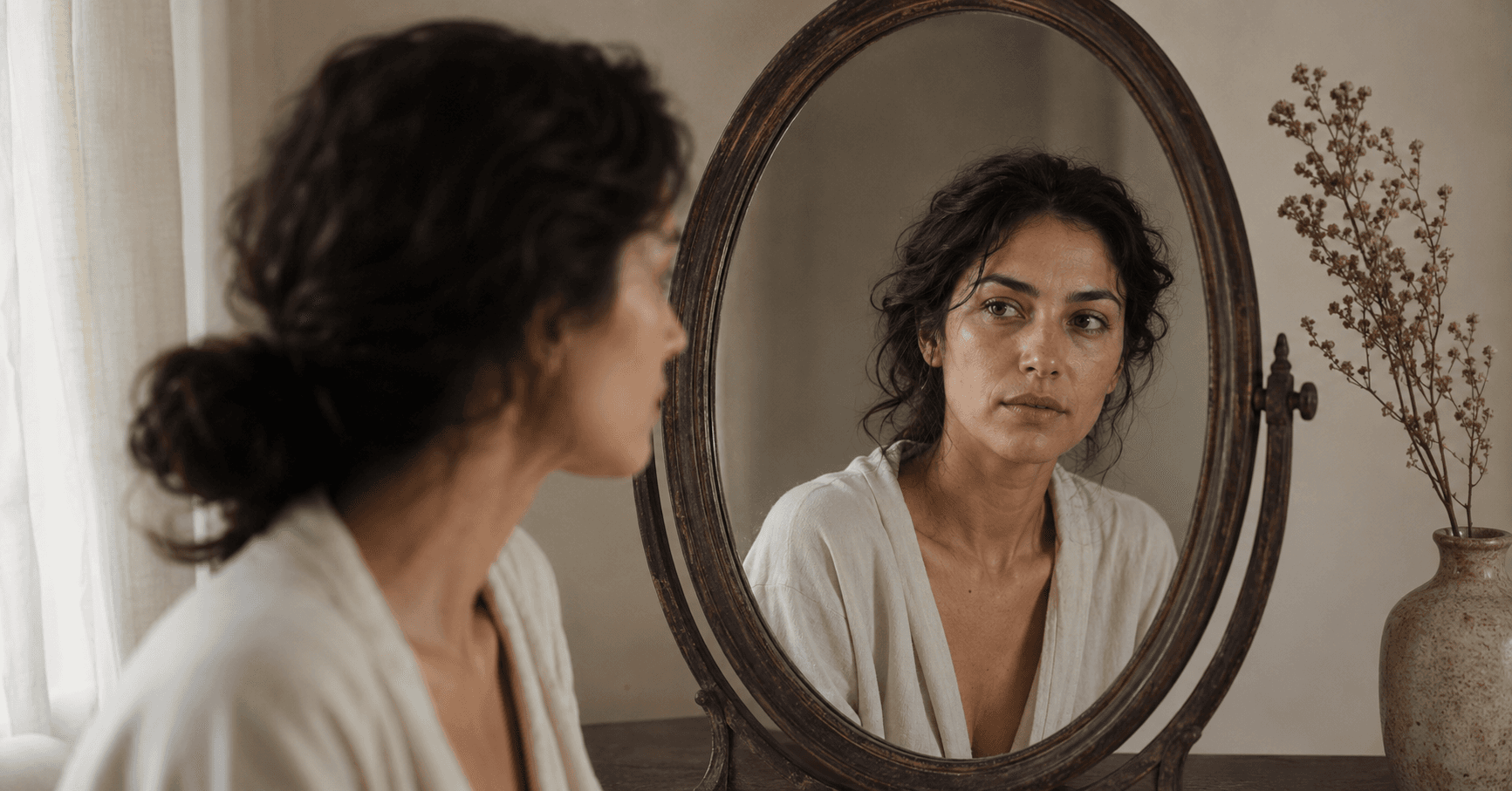
Sit down in front of a mirror. No makeup. In natural light (a window, around midday if possible). Look at yourself for five minutes. Not to find "problems". You have that list memorised already. Look at your face as a whole — the proportions, how the light falls across your cheeks, the shape of your mouth, how your brows intersect.
That's the face I'll work with. That's the face I'll let be exactly what it is, only with a little more light.
It isn't magic
Makeup has a reputation for being transformative. "Before and after" photos are viral for that reason. But the best makeup I've done in the last four years doesn't look like a transformation. It looks like — this woman is having a good day.
That's the goal of every session I have in Skopje or Gostivar. Not a new woman. The same woman, on her best day.
For the women who feel shy
If you've read this far and the shame is smaller, that's the point. Calling a makeup artist isn't a luxury. It isn't a sign of vanity. It isn't abandoning yourself.
It is, if you ask yourself the right question, a moment in which you tell yourself that your appearance on certain days deserves extra attention. That you aren't obligated to handle everything alone. That the care you give to others can also be turned toward yourself.
And it is, if you trust me on this, what I learn every week from the women who sit in that chair — that care for appearance isn't shallow, unless you let it be.
Frequently asked questions
ABOUT THE AUTHOR
This text isn't a confession. I'm not offering a "process". I just think it's worth writing about when makeup is a good idea and when it isn't, from the perspective of someone who does it every day.